Table of Contents
Podcast

October 3, 2026 · Season 2 : Project Manage This Mama · Episode 02
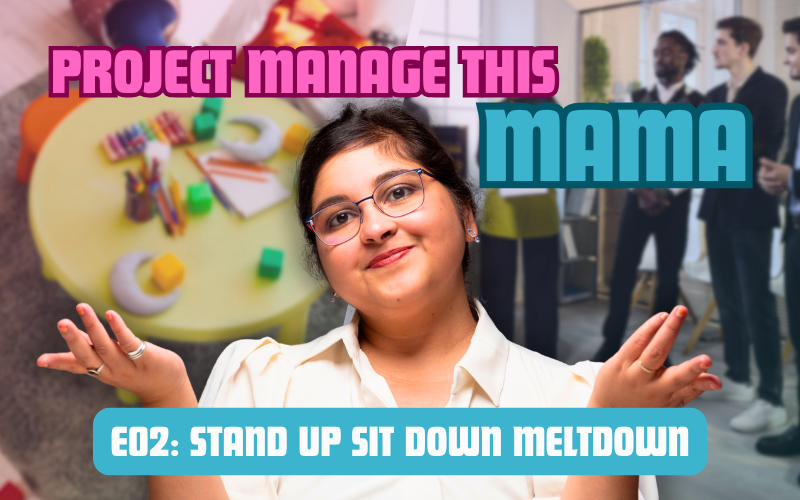
Stand Ups, Sit Downs, Meltdowns
19 Min, 47 Sec · By admin
Capacity planning for working mothers: how buffer, invisible work and Plan B create a more humane week when real life intervenes
Blog
Capacity planning when real life intervenes
A full calendar is not a realistic plan. Capacity includes energy, care work, dependencies, and buffer.
This episode is a small return to Project Manage This Mama after a long pause. I had promised that the next episode would be about time management, calendars, and everyday life. The funny thing is that the pause itself became the most convincing example of the topic. Life became full in ways that did not fit neatly into a content calendar. I needed time, then more time, and eventually I decided that if I waited for the perfectly clear week, I might never press record again.
So here I am, planning around real life to make an episode about planning around real life.
A Full Calendar Is Not a Realistic Plan
For a long time, I confused productivity with a full calendar. If the day was packed with meetings, work blocks, pick-up, dinner, and everything else that makes a household function, I felt prepared. But a full calendar is not necessarily a realistic one.
My daughter is no longer willing to be called a toddler. She is, very firmly, a small child now. But the lesson has stayed with me through these years of parenting: I cannot optimise every minute of family life. What I can do is leave enough buffer that, when life changes its mind, I still have somewhere to stand.
Capacity is not just back-to-back calendar events. It also includes energy, care work, dependencies, and buffer.
A calendar can show that I have two hours available. It cannot promise that I will have two hours of focused attention, a calm nervous system, a cooperative child, and enough energy left to make good decisions. Those are resources too.
When a Perfectly Planned Day Changes at Four O Clock
A familiar example: I have a work meeting at eight the next morning. My husband is meant to manage drop-off. The next day is also an office day for me, so the timetable seems tight but workable. Then, in the late afternoon, he calls. An urgent meeting has become a customer visit on the other side of the country. He will leave at seven thirty. He cannot do drop-off. Suddenly, the plan is not only different for him. It is different for all three of us.
Before motherhood, I might have looked at that calendar and asked, “Why could you not plan this better?” Now I know that the missing piece is not discipline. It is a dependency. Somebody needs to be present for the small human whose schedule cannot simply be moved by a meeting invite.
There are still choices. I can see whether the meeting can move slightly. I can tell the kindergarten that we will arrive later. I can message the colleague who expects me in the office. I can get up earlier and prepare breakfast, bags, and my own work material before the meeting begins. My daughter can eat breakfast beside me while I log in, because she is now old enough to manage a breakfast plate without me chasing after her. That is progress, even if it is not the sort that appears in a Gantt chart.
We are, in any case, not really an early-Kindergarten family. We are a slightly-late-Kindergarten family. So I negotiate with the reality we already have, not with an imaginary family who happily appears at the gate twenty minutes before opening.
Invisible Work Is Still Work
The visible appointment is only the smallest part of the task. Before an eight o clock meeting, there may be breakfast, clothes, packing, messages, a child who wakes up early, or a child who wakes up at seven thirty and refuses to get dressed until seven fifty-five. There is the preparation nobody sees, the emotional regulation nobody logs, and the mental load of holding several back-up plans at once.
I have the privilege of Gleitzeit and generous home-office flexibility. I can sometimes move away from my desk for ten minutes and come back. Not everybody can. If I had to be physically present in the office at eight, I would have fewer options. I might need to use time off, make a complicated childcare arrangement, ask a neighbour for a favour, or accept that something has to move.
That is why invisible work belongs in the scope. It is not a side note to the “real” work. It is part of the system that makes any of the visible work possible.
The Stand Up
At work, we use stand-ups when a project is critical, under pressure, or simply needs alignment. Family life needs smaller, kinder versions of the same practice. A real-life stand-up can be a quick check-in with yourself or your partner: What is essential tomorrow? What can move? Where is the pressure point? What needs to be communicated now, before it turns into an emergency at eight o clock?
In the example above, the most useful thing my husband did was call before he agreed to the trip, not come home at eight in the evening and casually mention that he would leave at seven the next morning. We could look at the whole system together. If I had had a medical appointment or an important commitment planned months earlier, that would have changed the decision. Alignment does not remove difficulty. It gives difficulty somewhere to go.
The Sit Down
The sit-down is what happens after the change. It is the moment where we stop trying to force the original plan through and decide what needs to give.
- Reduce the scope. An office day may become six hours instead of eight.
- Redistribute or ask for support. Perhaps a neighbour can help, perhaps a meeting can be moved, perhaps somebody else can take part of the load.
- Consciously delay something. It matters that the delay is a decision, not a private accusation.
An unfinished task is not a moral failure. It is a backlog.
In project work, a backlog is not proof that the team is useless. It is a visible record of what remains after the available capacity has been used. Real life deserves the same generosity. If a task did not happen because family life required a re-plan, the task did not become evidence that I have failed. It simply belongs to another day.
The Meltdowns Are Not Only Theirs
We plan for tasks, but not always for the emotional capacity required to hold them. A child’s meltdown is one kind of disruption. Our own exhaustion is another. It is emotionally expensive to coordinate everything, absorb a sudden change, reorient the next day, and still behave as if nothing happened.
I do not think the goal is to prevent every meltdown. Children process hard feelings out loud. Adults often try to process them by becoming quieter, more efficient, and more tightly controlled. But we do not have to absorb everything alone. We can write it down, ask for help, choose takeout when dinner has become too much, or let a child watch television for half an hour because the person responsible for creating the beautiful evening activity has run out of capacity.
Sometimes the most realistic risk register for the day is: nobody has slept enough, and snacks are now a critical resource.
A Practical Reframe
I am trying to leave three things intentionally unplanned each week. One of them is often a play date. Play dates depend on other parents and other children, but they are also one of the ways I see friends and get to sit down for a real conversation. Leaving room for one does not make my plan inefficient. It makes it human.
When a plan goes wrong, I am trying to ask a different question. Not, “What did I do wrong?” But, “What changed?” And instead of asking why I could not do everything, I ask what I realistically have room for this week.
We do not need to turn motherhood into a project plan. But we do need to stop expecting ourselves to carry a complex human system as though it were invisible, effortless, and endlessly expandable.
A humane plan is not the one that fits everything in. It is the one that leaves room for people and for real life to happen.
We are all trying to do the best we can with what we have. Sometimes the most capable thing we can do is make the plan a little more honest.
You can discover more here: Project Manage this Mama
Here the podcast in Youtube : TanniTalks Youtube